DIY Vertical Axis Wind Turbine Guide
Wind power is one of the most practical and beginner-friendly renewable energy technologies available today. A DIY Vertical Axis Wind Turbine (VAWT) is compact, efficient in low-wind conditions, and ideal for small-scale electricity generation projects.
Unlike traditional horizontal wind turbines, a vertical axis design can rotate regardless of wind direction. This makes it highly suitable for rooftops, balconies, and urban environments where wind flow changes frequently.
What Is a Vertical Axis Wind Turbine?
A Vertical Axis Wind Turbine is a wind-powered device in which the main rotor shaft is positioned vertically. The turbine blades rotate around the vertical shaft and transfer mechanical energy to a generator or DC motor.
Key Advantages of a Vertical Axis Wind Turbine
- Operates in changing wind directions
- Easier rooftop installation
- Produces less noise than large horizontal turbines
- Excellent for STEM and educational projects
- Compact and visually attractive design
- Suitable for small urban spaces
Because of these advantages, vertical wind turbines are commonly used in science projects, renewable energy demonstrations, and small off-grid applications.
Components Used in This DIY Wind Turbine Project
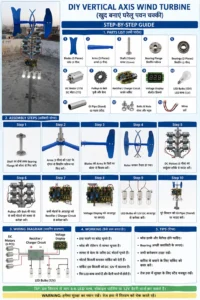
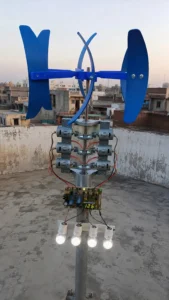
This DIY wind turbine uses multiple small DC motors connected through gears to generate electricity from rotational motion.
Required Materials
- Vertical turbine blades
- Metal or PVC central shaft
- DC motors – https://amzn.to/42NV879
- Spur gears
- Bearings
- Support frame
- Voltage display module – https://amzn.to/4o4vR2p
- Voltage Booster Module – https://amzn.to/4v5OCoj
- LED bulbs – https://amzn.to/4dFnSnv
- Electrical wires and connectors
- Metal stand or mounting base
Optional Upgrades
- Battery charging module
- Rechargeable battery storage
- USB charging output
- Waterproof protective enclosure
These additional components can improve usability and make the system more practical for real-world applications.
How the DIY Wind Turbine Works
The working principle is simple and effective.
Step-by-Step Working Process
- Wind strikes the turbine blades.
- The blades rotate the vertical shaft.
- Gears transfer rotational energy to the DC motors.
- The DC motors function as generators.
- Generated electricity powers LEDs or charges a battery.
As wind speed increases, the turbine rotates faster, producing higher voltage output.
Why Vertical Axis Wind Turbines Are Popular
1. Better for Urban Environments
Traditional horizontal windmills require direct wind alignment to operate efficiently. Vertical axis turbines work from multiple wind directions, making them more suitable for rooftops and crowded cities.
2. Easy DIY Construction
The mechanical structure is simpler compared to large horizontal wind turbines, making it ideal for beginners and hobbyists.
3. Excellent Educational Value
This project is highly useful for:
- STEM education
- School science exhibitions
- Renewable energy demonstrations
- Engineering experiments
- Robotics and electronics learning
4. Lower Maintenance
Most moving components remain near the base of the turbine, making maintenance and repairs easier.
Tips to Improve Wind Turbine Performance
If you want higher efficiency and better electricity generation, focus on these improvements.
Use Lightweight Blades
Heavy blades reduce startup speed and efficiency in low wind conditions.
Improve Gear Alignment
Poor gear contact causes energy loss and unnecessary friction.
Use High-Quality Motors
Better motors generate more stable voltage and improved power output.
Reduce Friction
Install smooth bearings on the central shaft for efficient rotation.
Increase Blade Surface Area
Larger blades capture more wind energy and improve performance.
Applications of DIY Vertical Wind Turbines
Small DIY wind turbines can be used in many practical and educational applications.
Common Uses
- LED lighting systems
- Battery charging
- Science fair projects
- Emergency backup power
- Smart renewable energy experiments
- IoT and sensor-based systems
Small DIY models are mainly designed for learning and experimentation. Large-scale electricity production requires professional turbine systems with advanced engineering.
Safety Precautions
Follow these safety measures while building and testing the turbine:
- Secure the turbine firmly before outdoor testing
- Avoid sharp metal edges
- Protect electronic circuits from rain and moisture
- Keep all electrical connections insulated
- Prevent overspeed rotation during strong storms
Proper safety practices improve both durability and reliability.
Conclusion
A DIY Vertical Axis Wind Turbine is an excellent renewable energy project for students, makers, and electronics enthusiasts. It combines mechanics, electricity generation, and clean energy technology into a practical hands-on learning experience.
With proper blade design, efficient gearing, and quality components, even a small turbine can generate enough electricity for LEDs, battery charging, and low-power applications.
This project is not only educational but also an effective way to understand how modern renewable energy systems work in real-world conditions.